Measuring Bacterial Burden at Closure
Bacterial burden at closure is measured by quantifying the number of viable bacteria remaining after lavage under controlled conditions, immediately prior to final closure.
Why these measurements are relied on
This evaluation is performed under defined conditions designed to isolate the effect of the lavage itself.
By standardizing bacterial exposure, lavage protocol, and recovery methods, the remaining bacterial burden at closure reflects the activity of the lavage rather than external variables.
Veterinary surgeons routinely rely on intraoperative and perioperative interventions that are evaluated based on their ability to reduce bacterial burden under defined conditions, including skin preparation, instrument sterilization, and systemic antimicrobial coverage.
How bacterial burden is measured
Defined inoculation
Known bacterial concentration introduced under controlled conditions.
Standardized lavage
Consistent volume, exposure time, and delivery method.
Neutralization
Lavage activity stopped prior to recovery.
Quantitative recovery
Remaining bacteria measured as colony-forming units (CFU).
This sequence allows the remaining bacterial burden at closure to be directly quantified under controlled conditions.
Why measurement at closure is used
Infection rates reflect multiple perioperative and postoperative variables, making it difficult to isolate the effect of intraoperative interventions.
Measurement at closure evaluates the condition of the surgical site at the final point under direct surgical control, allowing intraoperative performance to be assessed independently of downstream factors.
Intraoperative lavage strategies are evaluated within this same framework, based on their effect on residual bacterial burden at closure.
Evaluating lavage strategies at closure
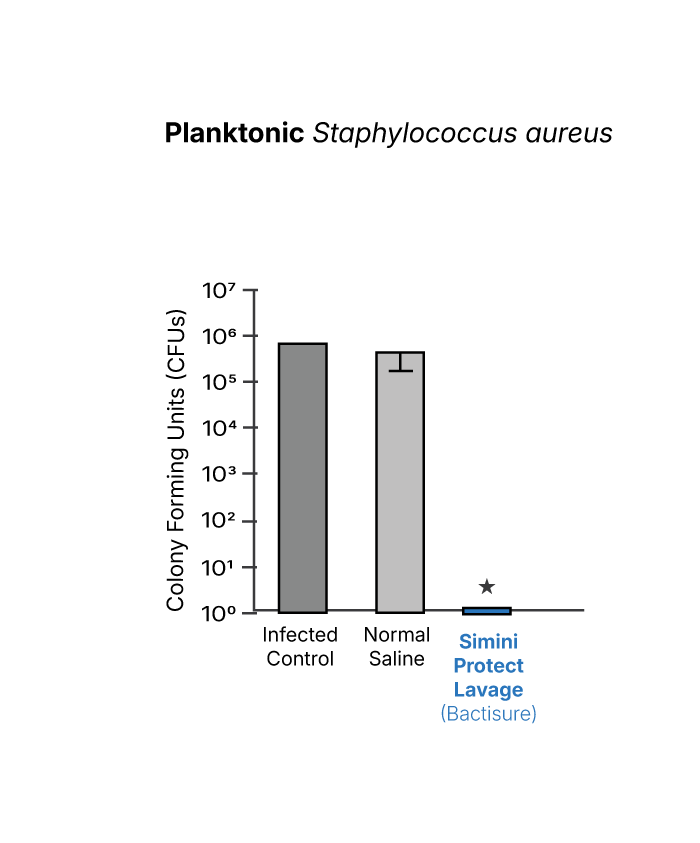
Within this framework, different lavage approaches can be compared based on how much bacterial burden remains at closure under identical conditions.
This includes evaluation of adjunctive lavage strategies studied alongside standard saline irrigation using the same controlled methods.
Simini Protect Lavage has been evaluated within this framework as an adjunct to saline irrigation, using standardized methods that measure residual bacterial burden at closure.
These methods form the basis for how intraoperative lavage strategies are evaluated.